Generative benchmark · defeasible reasoning · confirmation bias
DeReLab Defeasible Reasoning Lab Probing Defeasible Reasoning and Confirmation Bias in LLMs with a Generative Benchmark

Accepted at EMNLP 2026

DeReLab generates multi-turn conversations from formal reasoning graphs with ground truth computed by a path-relation algorithm. That lets us measure, precisely, when and how language models fail to revise their beliefs under incongruent evidence.

Jayanta Sadhu, Sayem Shahad, Kenneth Marino · EMNLP 2026

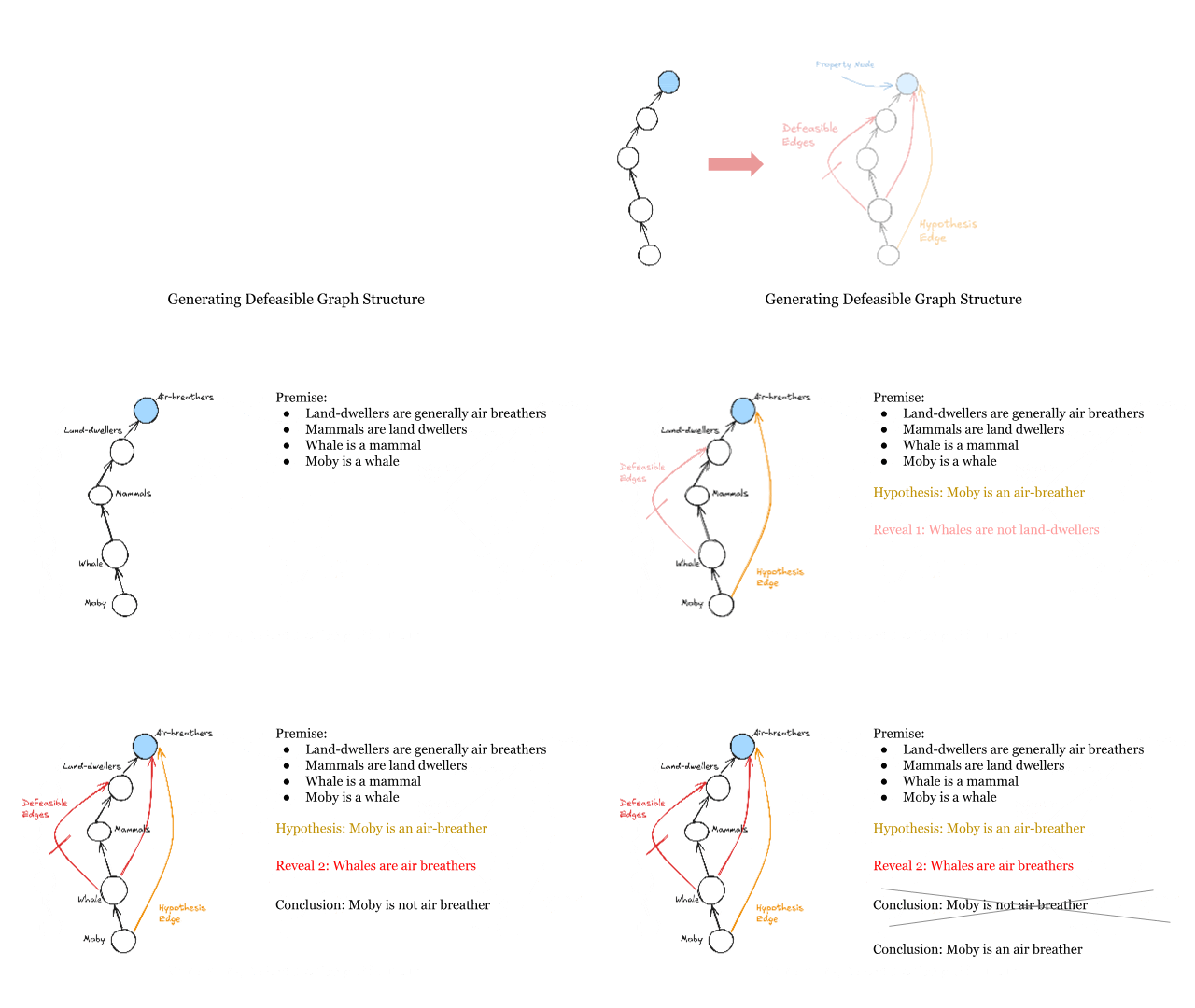
Animated walkthrough of a DeReLab example being generated step by step

See exactly how a DeReLab example is generated, step by step.
Background

What is defeasible reasoning?

Defeasible reasoning is a form of non-monotonic inference in which conclusions follow from default rules rather than strict logical entailment. A default rule licenses a conclusion in the absence of information to the contrary, but that conclusion is defeated once a more specific or stronger rule applies. Consequently, unlike classical entailment, a defeasible conclusion is not guaranteed to persist as new premises are added — it can be withdrawn without contradiction.

A model capable of defeasible reasoning revises its answer the moment it learns Tweety is a penguin. DeReLab measures exactly this kind of belief revision, at scale, against formally verified ground truth.

Why DeReLab

A benchmark that generates itself, on demand, at any scale

Static benchmarks can leak into training data and reward pattern matching over genuine reasoning. DeReLab instead builds a fresh directed reasoning graph for every example, as many as you need, and converts them to multi-turn conversations. Because every graph is generated procedurally rather than hand-written, and our path resolver algorithm can always recompute the correct answer after each reveal — so every freshly generated example still comes with a verified ground-truth label, not a human annotation.

10
model – inference configurations evaluated
17
model × reasoning-type cells show significant confirmation bias
3
reasoning topologies: default, linear inheritance, tree inheritance
0.949
ICC across 20 independently seeded draws — scores are reproducible
Reasoning topologies

Three ways to stage defeasible evidence

Each topology is generated at easy and hard difficulty, producing six reasoning conditions per model.

Default

Property-chain reasoning

A linear chain of properties with defeasible updates, distractor attributes, and source-priority conflicts between named sources.

Linear inheritance

Single-lineage taxonomy

A class hierarchy where properties propagate down one lineage — the simplest inheritance structure, used as a controlled baseline.

Tree inheritance

Branching hierarchy

A stochastically-grown taxonomy tree where updates on one branch can, or deliberately cannot, affect a sibling branch. Explore this one live in the simulator.

Key findings

What the benchmark reveals

01 Confirmation bias is near-universal.

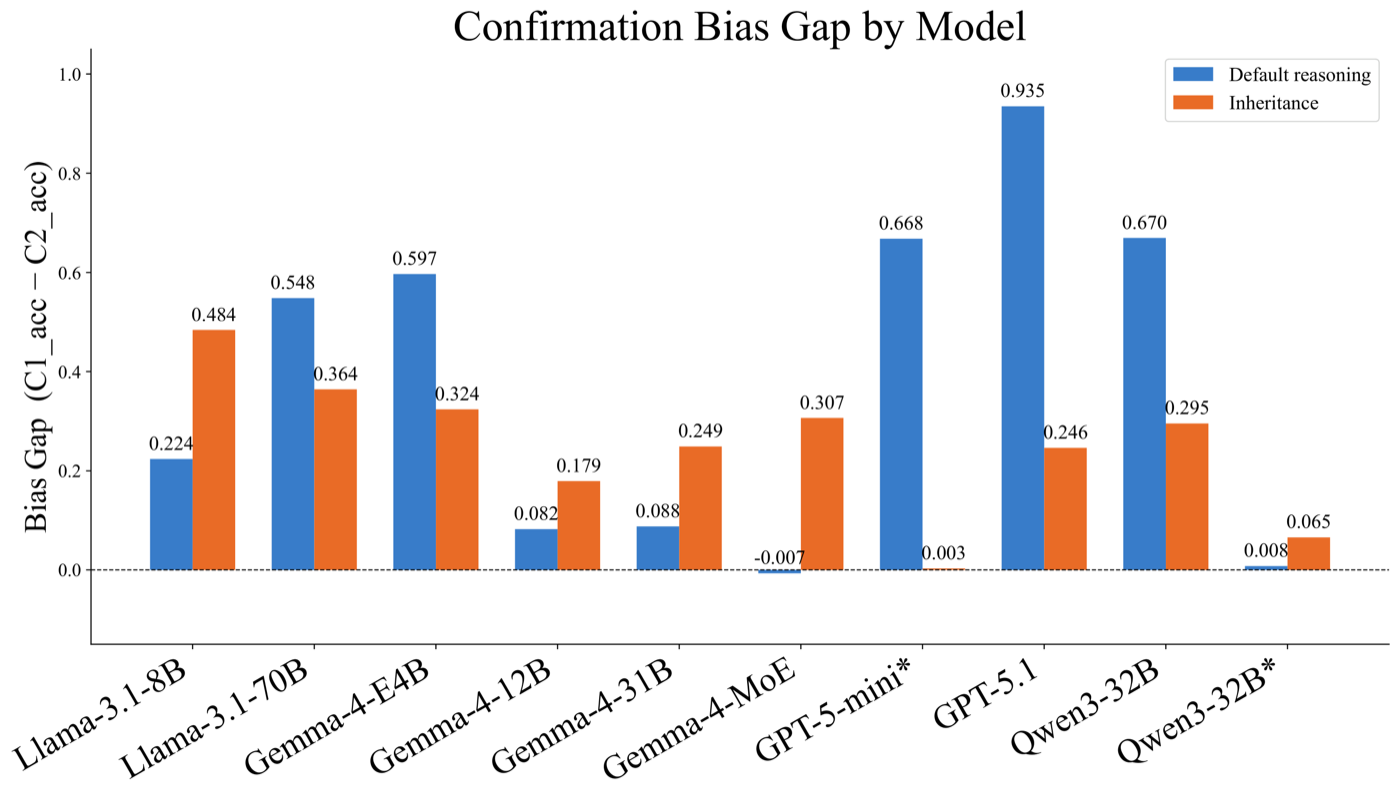
Almost every model we tested shows this bias, from a small effect in Gemma-4-12B to a huge one in GPT-5.1.

BiasGap measures how much less accurate a model is on incongruent updates (which should overturn its current answer) than on congruent ones (which confirm it). Gemma-4-12B shows a small but reliable gap, while GPT-5.1 reaches near-total incongruent failure — a congruent accuracy of just 3.5% means the model almost never correctly revises from yes to no when faced with a weakening update. Only two setups showed no clear bias at all: Gemma-4-MoE on default reasoning, and Qwen3-32B with extended thinking on inheritance reasoning.

Bar chart of confirmation bias gap per model, split by default and inheritance reasoning

Confirmation bias gap (congruent accuracy − incongruent accuracy) per model and reasoning type.

02 Models often know but don't say.

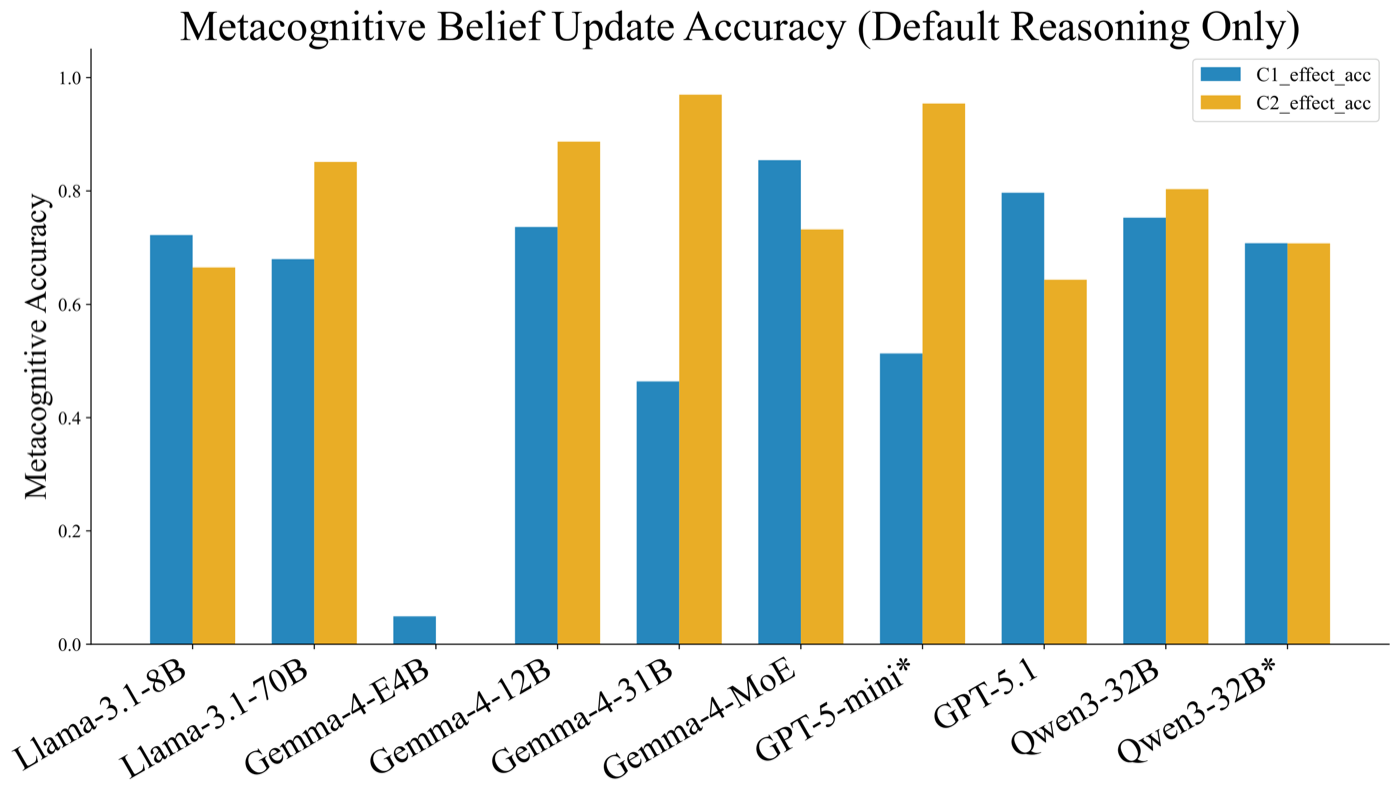
Several models correctly label an update as weakening on the majority of incongruent turns yet almost never revise their entailment answer — e.g. GPT-5-mini: 95.4% effect accuracy vs. 20.3% entailment accuracy on the same turns.

Llama-3.1-70B shows the same pattern (85.1% effect accuracy vs. 14.9% entailment accuracy): both models correctly identify weakening on the majority of incongruent turns yet almost never revise their entailment answer accordingly. Gemma-4-31B presents the subtler end of the same pattern — the highest effect accuracy of any model (97.0%) alongside a high entailment accuracy (90.7%), for a smaller but still reliable dissociation. This know-but-don't-output pattern suggests confirmation bias operates as a belief-revision suppression effect: models correctly encode the evidential direction of an update but fail to propagate it to their entailment answer.

Grouped bar chart comparing effect-labelling accuracy on congruent vs incongruent turns, per model

Effect-labelling accuracy on congruent (strengthening) vs. incongruent (weakening) turns, per model, default reasoning only. A large gap — high effect accuracy but low entailment accuracy on the same turns — is the know-but-don't-output signature.

03 That effect-labelling accuracy is scaffolded, not independent.

Reversing question order (effect question first) collapses effect-labelling accuracy across every tested model, showing it was primed by prior engagement with the entailment question rather than reflecting standalone understanding.

We re-ran six models with the question order reversed — effect question before entailment. The confirmation-bias gap itself is robust to order — it holds or grows for five of the six models, and is essentially unchanged for the sixth — but C2-effect accuracy collapses everywhere it started high, and Gemma-4-MoE's apparent absence of bias in the standard order turns out to be a sequencing artefact: its BiasGap rises from −0.007 to 0.259 once the entailment question no longer comes first.

BiasGap (C1 acc − C2 acc) under the standard question order vs. the effect-question-first reversal, default reasoning, six models.

04 Extended thinking suppresses default-reasoning bias.

Qwen3-32B with extended thinking reduces default BiasGap from 0.67 to 0.008, though the benefit is much smaller on inheritance reasoning.

The standard (non-thinking) Qwen3-32B shows a default BiasGap of 0.670 — one of the largest in the evaluation. Qwen3-32B* (extended thinking) reduces this to 0.008, with the lowest anchoring rates of any model on both topologies. Gemma-4-MoE achieves near-zero default bias via a different mechanism, but its inheritance bias remains substantial (Gap = 0.307), showing that suppression does not automatically generalise across reasoning types. See the chart in finding 01 above for the full model-by-model picture.

05 Confidence decays with inference depth.

On-path correct-answer confidence declines the further an update sits from the question, for most models under hard tree-inheritance conditions.

When an update sits many reasoning hops away from the question being asked, most models become steadily less confident in the correct answer, even when that answer hasn't actually changed — the connection just gets harder to track the further away it is. This effect is strongest for Gemma-4-31B and Llama-3.1-8B, whose confidence erodes the most over long chains. GPT-5.1 is the one clear exception: its confidence in the correct answer actually grows with distance, suggesting it accumulates supporting evidence across a chain rather than losing track of it.

06 Benchmark scores are stable across resamples.

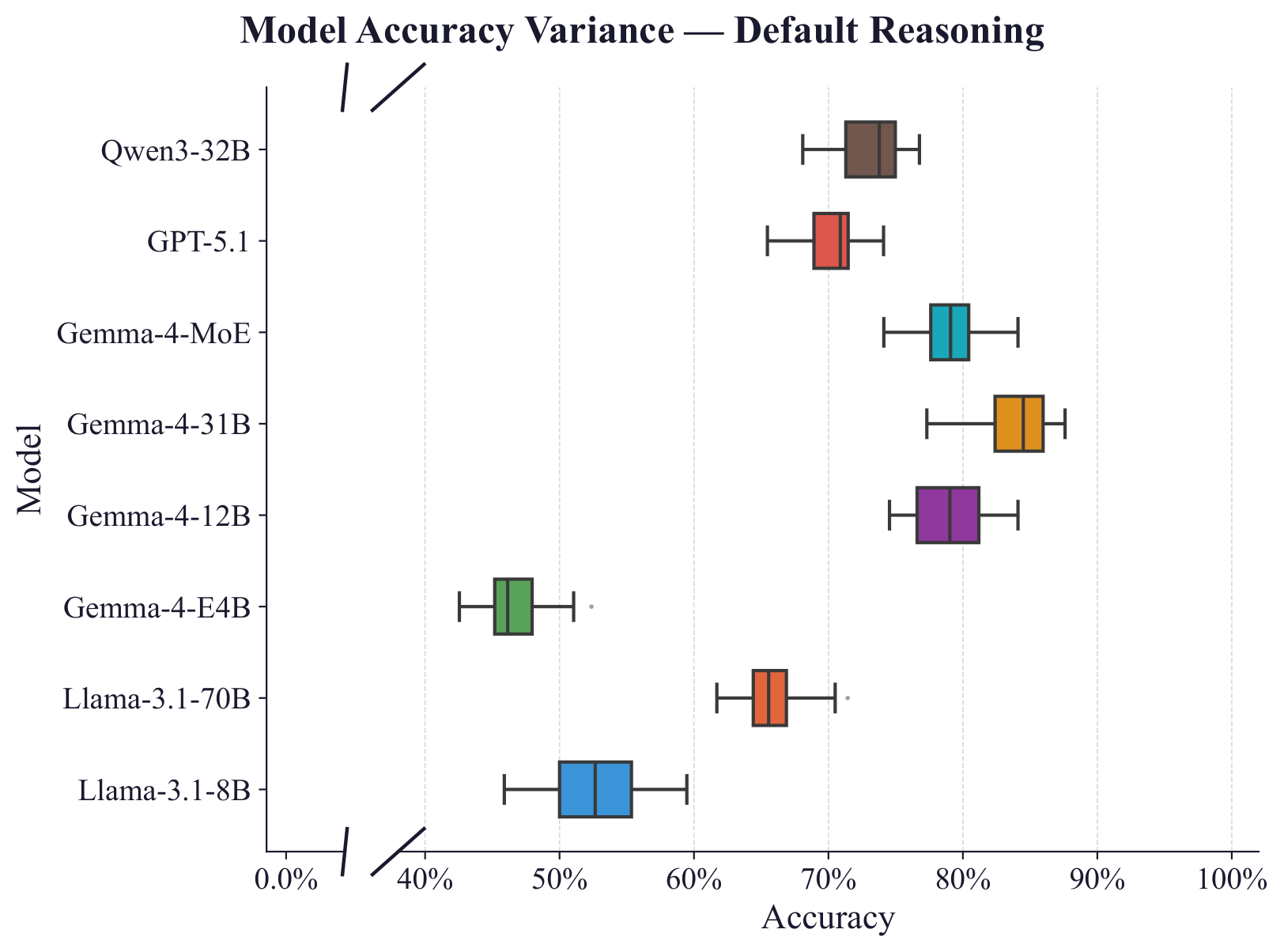
Re-running the benchmark with 20 different random seeds gives nearly identical scores every time.

None of the 20 reruns produced a meaningfully different score for any model. The two models with the most variation — Gemma-4-E4B and Llama-3.1-8B — are also the lowest-accuracy models, where more fluctuation is expected, and even their spread is small. A different seed would not change any model's accuracy category.

Chart of accuracy variance by property chain length across 20 seeds, per model, default reasoning

Accuracy variance across 20 independently seeded draws, by property-chain length, default reasoning. Overlapping bands across seeds indicate stable model behaviour rather than draw-specific artefacts.

Models evaluated

Nine base models, ten configurations

GPT-5.1 GPT-5-mini Qwen3-32B Qwen3-32B (extended thinking) Gemma-4-31B Gemma-4-12B Gemma-4-MoE (26B-A4B) Gemma-4-E4B Llama-3.1-70B Llama-3.1-8B

See how one example is built, end to end

Step through structure generation, population, natural-language verbalization, and staged skeptical reasoning — the exact pipeline used to produce the benchmark, running live in your browser.

Open the data generator →
Cite this work

Citation

@inproceedings{sadhu-etal-2026-derelab,
    title     = "{D}e{R}e{L}ab: Probing Defeasible Reasoning and Confirmation Bias in {LLM}s with a Generative Benchmark",
    author    = "Sadhu, Jayanta  and
      Shahad, Sayem  and
      Marino, Kenneth",
    booktitle = "Proceedings of the 2026 Conference on Empirical Methods in Natural Language Processing",
    month     = oct,
    year      = "2026",
    address   = "Budapest, Hungary",
    publisher = "Association for Computational Linguistics",
}